
Hello hello everyone!
I hope you all have had a lovely weekend and are looking forward to the remaining warm weeks left of the summer season before autumn’s arrival. I certainly am, though it seems this next week ahead, for me, will be one spent drafting some brief preliminary research for a few papers I wish to compose.
The Association of Historians of Nineteenth-Century Art (AHNCA) and the College Art Association (CAA) – avid promoters of scholarship within the visual arts which I am a member of, have put out calls for papers that center on nineteenth-century visual and decorative materials’ linkages to the socio-historical and cross-cultural temperaments of their respective geographies, as well as to these materials’ relationships and connections to their environment(s) and ecologies. I wish to answer these calls, yet before I do, I wanted to throw out an idea I had for one of them and get some of your thoughts on the subject I have in mind.
In the time I’ve spent thus far at the Musée within Maine’s Saint John Valley, I’ve become greatly interested in investigating the institution’s abundant collection(s) of delicate, handwoven fabrics, textiles, and garments – particularly those that once whole-fully formed the trousseau(s) of the young Francophone women who historically inhabited the borderland that is northern Maine and southern New Brunswick, a region rich in Acadian and French-Canadian heritage.
A collection of clothing, accessories, bedroom linens, and household belongings (e.g., hand towels, table runners) often prepared for and/or by a bride-to-be, a trousseau served both utilitarian and visually appealing purposes. Such items were created in preparation for married life and, thus, were pivotal in the creation and decoration of a new household. Luminous wool blankets, richly sewn bed sheets and linens, cotton sleepwear, and bridal gowns and tablecloths adorned with exquisite lacework are hallmarks of the trousseau(s) of the former Francophone women within the Saint John Valley.
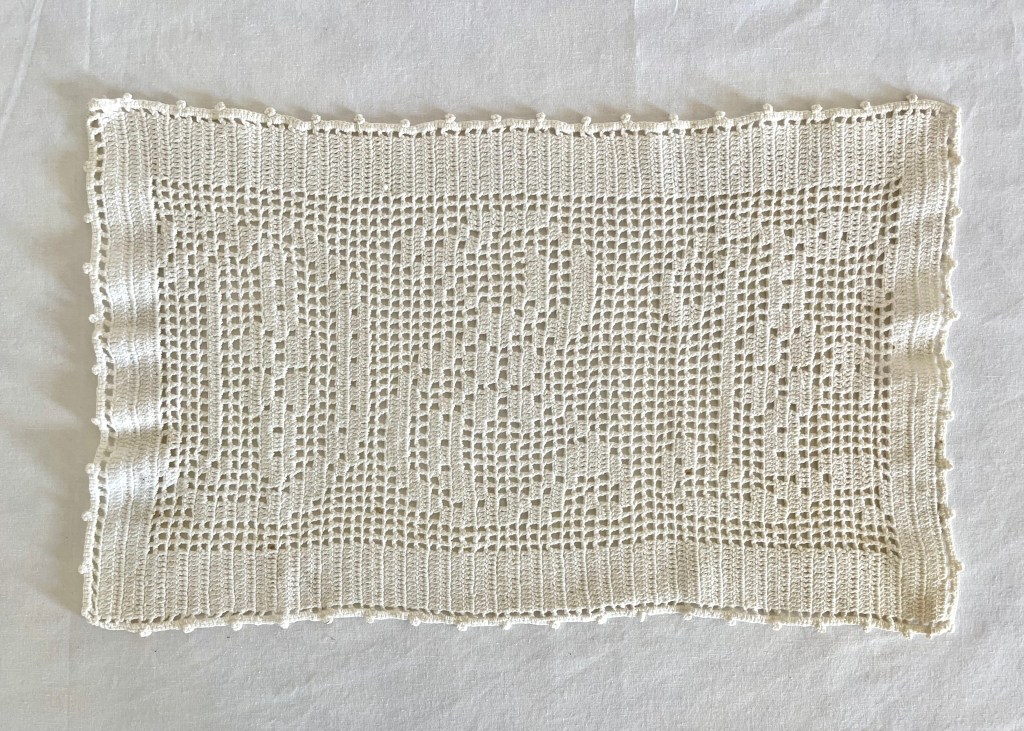
I wish to touch on how these items not only signify the self-sufficiency and creative resourcefulness of their Francophone makers, but are simultaneously emblematic of a resistance to cultural erasure.
As with many of the Musée’s artefacts, these too hold a direct and intimate connection to a human collective whom are entwined with histories of forced migration and cultural assimilation (e.g., le Grand Dérangement). Though these fabrics and textiles celebrate the development and progression of a woman’s life and livelihood, they are also markers of the gradual, temporal progression away from hideous and traumatic geopolitical histories of the eighteenth through mid-twentieth centuries whose effects can still be witnessed today.

As such, these fabrics and textiles produced by and for the women of the Valley’s Francophone peoples hold varied layers of meaning and significance that cannot be otherwise located elsewhere – geographically or temporally. I wish to explore how these items contributed to the formation of the personal and collective identities of the Saint John Valley’s past French inhabitants, as well as explore the broader intersectional issues that are embedded within them or that they may otherwise reflect.
What are your thoughts on this subject for study? Do you consider these items to be decorative or purely utilitarian in their fabrication? How might they be connected to the natural environment(s) and landscape(s) of the Saint John Valley in which they were produced? Do you consider these items can play a role(s) in wider conversations and discourses on ecology and climate, as well as on systems and infrastructures of imperialism, ethnic cleansing, and mass capitalist consumption?


 The Charette Cabinet
Leave a comment